What to Do When the Customer is Angry (And Your Agent is Wrong)
I was staring at a blinking cursor, trying to figure out how to respond to the profanity-laden rant of a frustrated customer. I had done everything in my power to resolve their problem, but every response I sent seemed to make it worse. The customer had decided I was an idiot, and no amount of evidence to the contrary would convince them otherwise.
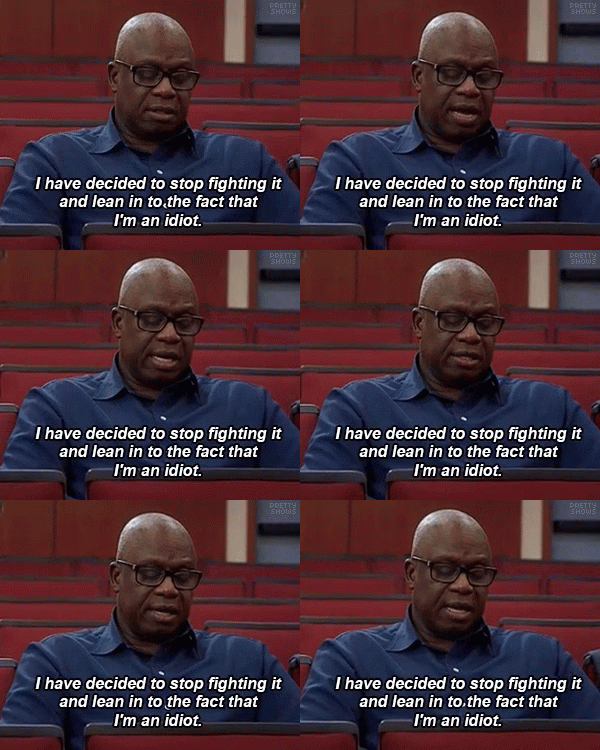
In their defense, looking back with fresh eyes, I did say things in my first response that an idiot would say—and exactly how an idiot would say them.
I’m not sure how I would have salvaged it, because I didn’t have to. My manager, Matt Cromwell—whose principles form the foundation of the Sustainable Support system—demonstrated immense courage by stepping in immediately.
What impressed me wasn’t just that he took over, but how he did it.
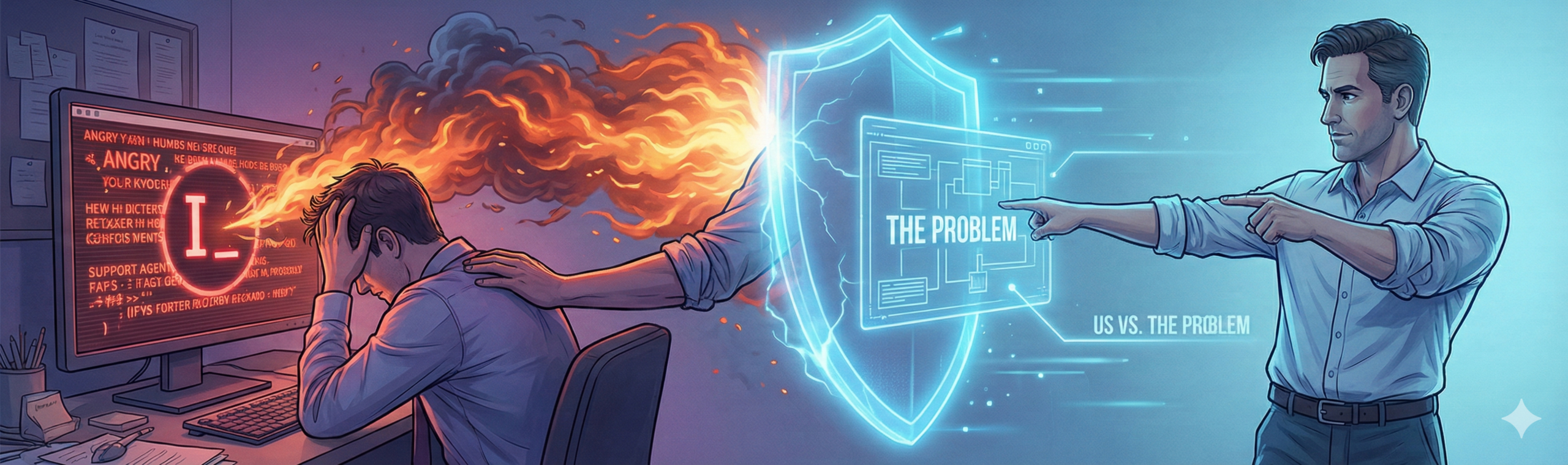
He didn’t pick a “side.” He could have easily (and correctly) told the customer, “Yeah, Ben really dropped the ball; he’s forgetful sometimes.” Instead, he ignored the profanity and carefully formed two teams: All of us (the web host, the vendors, the customer, and our company) on one side, and The Problem on the other. He unemotionally and directly addressed the issue, doing exactly what I should have done from the start.
After the dust settled, Matt did a deep postmortem with me. We looked at how things went sideways and discussed how to prevent it in the future.
The result was incalculable trust—both in him as a leader and in my own security at the company.
This is the reality of the Sustainable Support system: It is challenging. People are going to mess up. Even a decade in, there are still times where I read a situation incorrectly and need a different voice to bail me out.
If you are aiming for culture change—and that is what Sustainable Support is—you have to be ready to roll up your sleeves and enter the mess with your agents. You cannot ask your team to do something you are unwilling to do yourself.
Sometimes that means defending them from abuse; other times, it means letting them see you handle a situation so they can emulate it. And sometimes, it means letting them fail gently so they can succeed in the long run. The more drastic the culture change, the more your agents need to see you stepping in—not to do their jobs for them, but to demonstrate that you are undeniably in their corner.